
How Algorithm Works With AI SEO

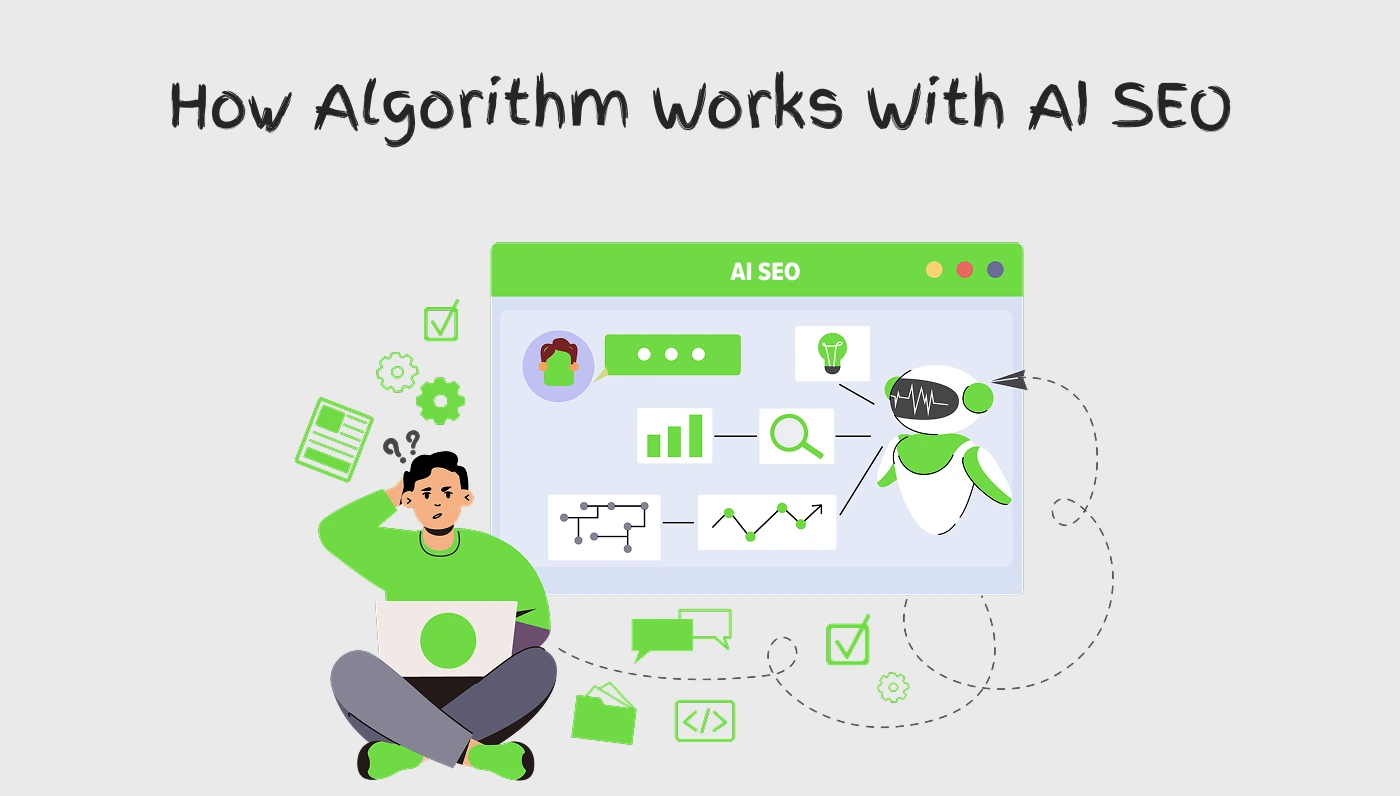
Think of Google a few years back: type a keyword, get a result. Simple. The algorithm behaved like a librarian who only searched for exact words you gave. But now? Google has turned into that super-intuitive friend who knows what you’re trying to say even when you don’t say it properly.
AI-based search doesn’t just scan keywords anymore, it watches how users behave, what they click, what they skip, how long they stay, and what they search right after. It connects the dots and says, “Oh, so THIS is what you actually meant.” That’s the new game. Google is reading intent, not just text.
And for businesses, this is a gentle nudge… or honestly, a loud wake-up call. If your content still talks like old-school SEO stuffed keywords, robotic tone, and no clarity, you’ll slowly slide down the rankings without even realising it.
To survive now, your content needs to be simple, crisp, helpful, and yes, AI-friendly.
In this article, we’ll walk through how AI-powered algorithms actually work today and how smart brands are adapting their SEO strategies to stay visible, relevant, and rank-worthy in this new era.
Introducing AI Based Search Algorithms
For effective SEO optimisation, AI-based search algorithms are becoming more important than ever. The evolution of AI in the IT industry has been happening for years, and now we’re finally seeing its real impact. The Google algorithm isn’t just checking keywords anymore, it can analyse a huge amount of data in seconds and actually understand the meaning and context behind a search query.
So now, it’s not just what people type but why they’re typing it. And that tiny shift has completely changed how SEO works.
How AI Based Search Algorithm Works
AI based search algorithm usually works with the combination of 3 components:
– Machine Learning.
– Natural Language Processing.
– Deep Learning.
Machine Learning models are trained on massive datasets to recognise patterns, behaviours, and relationships. They learn what makes content high-quality and which factors help a page rank better. Over time, they keep improving themselves based on user behaviour.
NLP takes things a step further. Instead of just matching keywords, it helps search engines understand the actual meaning and context of a query. Basically, it decodes what users really want, not just what they type.
Deep Learning adds the “brain” power. It uses neural networks to analyse data the same way humans process information. It helps Google understand tone, sentiment, content structure, and even whether something truly answers a user’s question.
Specific AI-Based Techniques Used By Search Engines Are:
RankBrain
RankBrain helps Google understand unfamiliar searches by learning from past data. It interprets user intent even when the query is vague or written in different ways.
Bert
BERT focuses on understanding the meaning between the words. It analyses context, sentence structure, and how users naturally speak to deliver more accurate search results.
How AI Has Impacted Traditional Search Algorithms
Let’s explore how traditional search algorithm is impacting AI:
Context Is the New King
Earlier, Google behaved like a strict keyword-matching machine. If someone typed “barber shop near me,” it simply scanned pages with those exact words. But AI has totally changed the game. Now, if a user searches “I need a quick trim before office,” Google understands they’re still looking for a barber shop even if the keyword isn’t mentioned.
AI reads intent, mood, urgency, and context. It knows what the user means, not just what they type. That’s the real shift from plain keywords to true understanding.
Writing More To Writing Better
Let’s be honest, writing a lot is easy. Writing something that actually helps someone? That’s the real game. You can publish 10 blogs a week, but if none of them add value or answer anything meaningful, what’s the point?
- Check if what you’re writing is actually relevant to what your audience wants to know right now.
- Add enough depth so the content doesn’t feel surface-level but genuinely answers the reader’s “okay, but tell me more” moment.
- Always make sure your content is providing real value that helps the reader in a practical way.
Engagement Metrics
AI is way more interested in how people interact with your content now. It is not just reading your words it is reading user behavior. And a few metrics speak louder than any keyword.
- Dwell time shows how long someone actually stays on your page. More time means your content is doing its job.
- CTR tells AI if your title and description were strong enough to make people click.
- Bounce rate shows how quickly users leave if they bounce fast. AI knows something is missing.
These signals quietly tell AI whether your content deserves the spotlight or not.
Which Strategies You Need To Adapt Now
If AI is getting smarter, your content needs to get smarter too. Gone are the days when stuffing keywords worked. Now your content has to feel human, sound natural, and match exactly what people are searching for.
Make Your Content Conversational
Write like you’re talking to someone sitting right in front of you. Simple words. Clear flow. Natural tone. For example, instead of “Our services are highly beneficial,” say “Here’s how this actually helps you.” AI loves this because users love it.
Add Long-Tail Queries
People don’t search like robots anymore. They type what they actually want.
For example:
Instead of “best moisturizer”, they search for “best moisturizer for dry skin in winter under 500.” These long-tail queries bring more qualified traffic and give you a higher chance to rank.
Leverage The Power of Structured Data and Schema Markup
- Structured data acts like a clear map for Google and AI to understand your content instantly.
- Schema markup labels everything on your page: this is a product, that is a review, this is an event.
- AI reads these signals and knows exactly how to display your content in search results.
- With this, your pages can appear in rich results, snippets, and FAQs, grabbing more attention and clicks effortlessly.
Create High-quality Content For Featured Snippets
AI-powered search prefers content that gives quick, crisp, straight-to-the-point answers. That’s why featured snippets exist. Google wants to save users time. If your content helps users get what they want in seconds, Google happily puts you in that top “answer box.”
- Use bullet points, short steps, and clean tables so your content looks organized and scannable.
- Give the direct answer first, right at the top, and then add supporting details below.
- Keep your sentences short, clear, and to the point so Google can easily lift that section and display it as the “quick answer.”
How Will AI Influence Search Engine Algorithms in The Near Future
Prediction #1: NLP Will Supercharge Voice Searches
- People don’t talk the way they type, and AI is finally catching up.
- Voice searches will sound more like “Hie Buddy, best budget phone under 10k?”
- NLP will decode accents, emotions, and messy phrasing and still deliver the right answer.
- So your content needs to feel like a real conversation, not a keyword puzzle.
Prediction #2: Search Results Will Become Hyper-Personalised
- Two people typing the same query will get totally different results.
- AI will read your habits when you click, skip, buy, or search at 2 a.m.
- This means generic content won’t work now; you must write for someone, not everyone.
- Personal relevance will beat raw keyword power.
Prediction #3: Visual Search Will Become the New Normal
- People will stop describing things and just upload a picture.
- People will search like “What lipstick shade is this?”
- AI will analyse photos, text, colours, patterns all at once.
- Brands with clean visuals, alt text, and helpful descriptions will rise faster.
Prediction #4: AI Will Prioritise Intent Over Exact Keywords
- Users will search like humans, not search engines and AI will love that.
- Even half-baked queries like “that brown chair from Instagram with wooden legs” will get accurate results.
- Your content must solve real problems, not just sprinkle keywords.
- Helpful, clear, detailed content will win… every time.
Wrapping Up,
Don’t forget to blend human expertise with AI-driven content.
As generative AI tools are becoming increasingly popular, and AI-based search is not slowing down anytime soon. But here is the part people forget… No matter how advanced these tools get, human expertise still sits at the centre. You need that mix of smart AI assistance and real human clarity to make your content powerful and future-ready.And if you feel this whole AI search algorithm world is getting a bit too much to handle, SEOBookLab is right here to guide you. We help you create content that works today and still makes sense tomorrow. Just reach out and let us handle the AI side of your SEO.